
HEI vs. HELOC vs. Closed-End Second: A Broker’s Guide
When a client has the equity but not the fit, the answer isn’t no — it’s a different instrument. Here’s how the three main ways to access home equity compare, side by side.
Every loan officer knows this file. Strong equity position, decades in the home — and a debt-to-income ratio or income documentation profile that doesn’t clear the box for a home equity line. The traditional playbook offers two tools for tapping equity without touching the first mortgage: a HELOC or a closed-end second. When neither fits, the conversation usually ends.
And it’s ending more often. Research from the Federal Reserve Bank of St. Louis found mortgage denial rates climbed from 12.2% in 2021 to 15.1% in 2024 as rates rose, with debt-to-income the leading reason — cited in 35% of denials. Home equity lines are hit hardest of all: HMDA data puts the HELOC denial rate at 47.59% in the fourth quarter of 2024 — nearly half of every application submitted — and in our view declination rates have continued to climb since, by our own estimate approaching the 80% range in parts of the market. Higher rates push more borrowers past DTI thresholds, which means more equity-rich clients hearing no on products that qualify on income. That is exactly the file the rest of this article is about.
It doesn’t have to end there. A third category — the home equity investment (HEI) — approaches the same equity from a different direction, and because it is not a loan, it doesn’t live or die on the same qualification criteria. For brokers, understanding how the three compare is the difference between a declined file and a client you helped anyway.
The three instruments, defined
HELOC
A home equity line of credit is a revolving, second-lien credit line. The borrower draws as needed during a draw period, typically paying interest only, then enters a repayment period where principal comes due. Rates are usually variable. Qualification runs on credit, income, and DTI — and the draw-period-to-repayment transition can bring meaningful payment shock.
Closed-end second
A closed-end second (home equity loan) delivers a lump sum at a fixed rate with a fixed maturity. Payments start immediately and continue until the loan is retired. It offers payment certainty, and it demands the same credit, income, and DTI qualification as any mortgage product.
CHEIFS® — a home equity investment agreement
CHEIFS (Cornerstone Home Equity Insurance/Investment Funding Solutions) is a home equity investment agreement — not a loan, and not a HELOC, ARM, or reverse mortgage. The homeowner receives a lump sum today in exchange for sharing a portion of the home’s future value. There are no new monthly payments — the homeowner remains responsible for property taxes, insurance, and maintenance — and the homeowner retains title and ownership of the home, subject to the agreement’s conditions on sale, transfer, and refinancing. The agreement is settled from the home’s value at a settlement event — a sale, a refinance, a permanent move-out, the homeowner’s passing, or whenever the homeowner chooses to settle. Because there is no loan, qualification is primarily equity-based rather than income-based.
Side by side
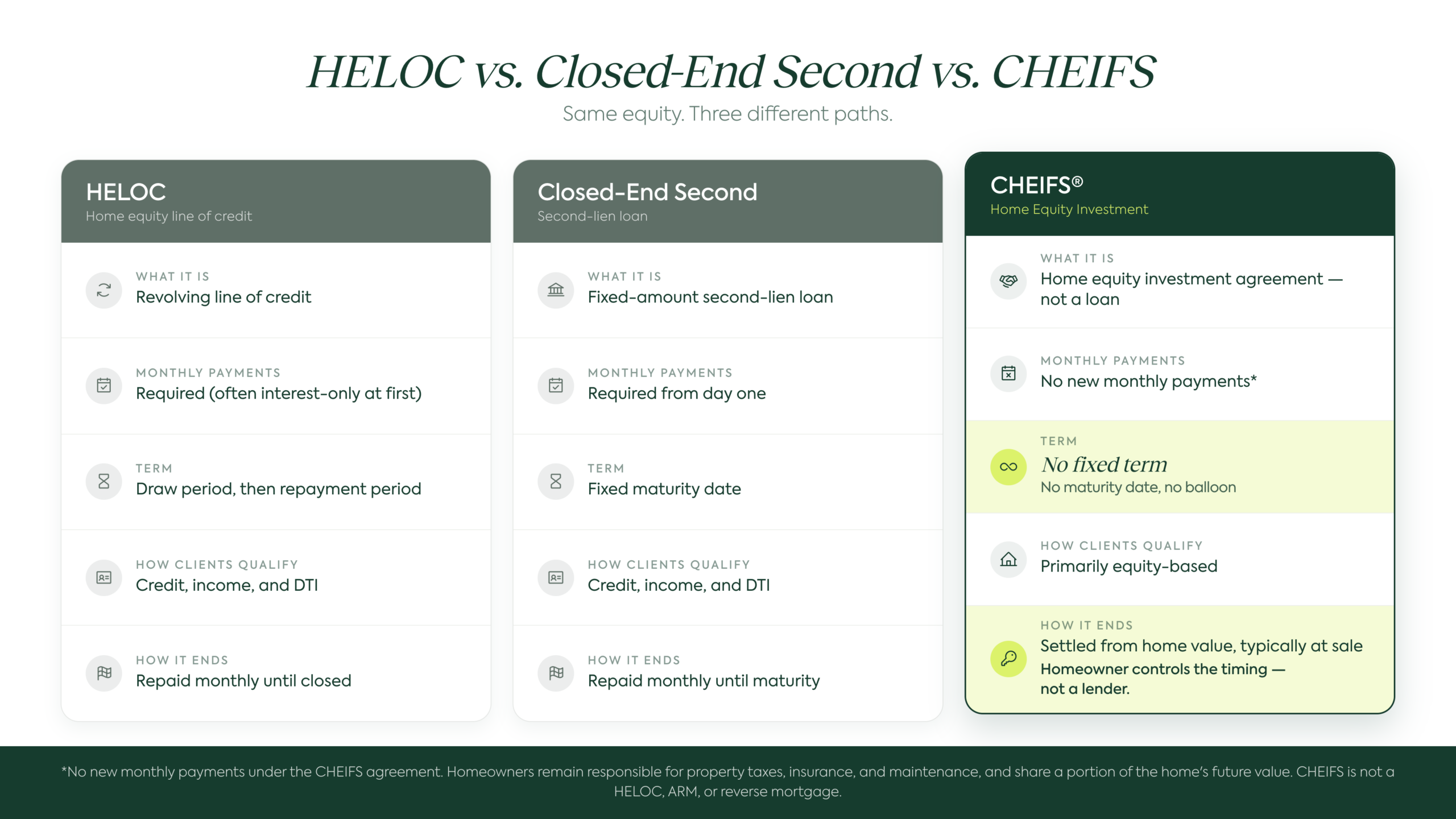
*No new monthly payments under the CHEIFS agreement. Homeowners remain responsible for property taxes, homeowners insurance, and home maintenance. In exchange for funds today, homeowners share a portion of the home’s future value.
The row that changes the conversation: no fixed term
A HELOC carries a built-in cliff — the day the draw period ends and interest-only becomes principal-and-interest. A closed-end second carries a maturity date from the moment it closes. Every loan against home equity puts the borrower on a clock.
A CHEIFS agreement has no fixed term in years, no maturity date, and no scheduled payments. The agreement is settled from the home’s value at a settlement event — a sale, a refinance, a permanent move-out, or whenever the homeowner decides to settle. The homeowner controls the timing — not a lender. For clients on fixed incomes, or anyone for whom a future payment increase is the exact problem being solved, this is frequently the deciding factor. The trade-off is stated just as plainly: the homeowner exchanges a share of the home’s future value for that flexibility.
What does it cost? An illustrative comparison
Because CHEIFS is not a loan, it has no interest rate and no APR. But brokers think in annualized-cost terms, so an equivalent-cost illustration is the fairest way to compare. Assuming 3% annual home price appreciation in a representative scenario, the effective annualized cost of a CHEIFS agreement is approximately 5.95%, including the origination fee — compared with roughly 5.97% on a 30-year fixed cash-out refinance and 6.36% on a HELOC.
Assumptions: figures as of September 2026; illustrative example only, not an offer of credit or a quote; the effective cost of a CHEIFS agreement varies with actual home price appreciation and time to settlement — stronger appreciation raises the effective cost, weaker appreciation lowers it; HELOC and mortgage figures reflect published market averages as of the same date.
Where each one fits
None of these products is categorically better — brokers may evaluate each against the client in front of them:
- A HELOC fits clients with strong income documentation who want revolving access and can absorb variable rates and the eventual repayment-period payment.
- A closed-end second fits clients who qualify on DTI, want a lump sum, and value fixed-rate payment certainty.
- A CHEIFS agreement may fit equity-rich clients who are income-constrained or documentation-constrained, clients who cannot or do not want to take on a new monthly payment, and clients whose first mortgage is too good to disturb.
That last profile deserves emphasis. A large share of today’s homeowners hold first mortgages at rates they will likely never see again. A cash-out refinance trades that rate away to reach equity. All three options above preserve the first mortgage — but only one of them preserves it without adding a new monthly obligation on top.
A quick fit screen before you send a file
CHEIFS is not the right answer for every file. These four checks will tell you in about a minute whether a scenario is worth a conversation:
- Occupancy: primary residence or second home — single-family, PUD, townhome, or condominium.
- Credit: a minimum representative credit score of 680 for each managing homeowner. Exceptions are available for hardship-affected scores and first-lien applicants — and with two homeowners, one score may be 620+.
- Equity and existing liens: existing liens, any undrawn credit lines, and the equity share together must fit within the program’s Total Home Encumbrance limit. Clients with 40% equity or more are best positioned to benefit.
- Location: currently accepting applications in AZ, CA, DC, DE, FL, ID, IN, MO, NH, NJ, NM, NV, OH, OR, PA, SC, TN, UT, VA, VT, WI, and WY — and growing. The current list is always at cheifs.com/mortgage-brokers.
If a file clears these four, it is worth a conversation. If it is close on one — particularly credit score — ask before ruling it out. Guidelines are subject to change; final eligibility is determined by underwriting.
How one broker partner is using it
One of our established broker partners added CHEIFS to its product matrix for a simple reason: one more tool on the shelf. Then their own fallout review turned up something worth acting on. A meaningful share of their second-lien fallout traced back to DTI or income documentation — including self-employed borrowers. Those are exactly the files that can still work with CHEIFS, which is qualified primarily on equity and credit rather than on income.
Today they present CHEIFS alongside the HELOC application, with the client’s knowledge, as an alternative and a fallback. It does not replace the loan. It is there for the homeowner with an immediate need for cash who is otherwise credit- and equity-qualified — and who would otherwise walk away with nothing. The broker keeps the file and the relationship, and the client learns about an option they might never have found on their own.
It is worth checking whether your own fallout looks the same. Pull your last 90 days of declined or withdrawn second-lien files and send us the ones where equity was strong and income was the problem — no client names needed, just the same basics as the scenario desk below. We will tell you which would have fit before anyone fills out an application.
What this means for a broker’s business
The practical value of the comparison isn’t academic — it’s retention. When a loan is the right answer, brokers already have the tools. When it isn’t, the file traditionally leaves the building, and often the relationship leaves with it. A wholesale HEI program gives originators a structured way to serve the client who doesn’t fit the rate sheet: brokers in participating states can offer CHEIFS directly through the wholesale channel, and loan officers everywhere CHEIFS operates can refer clients and stay in the relationship. Either way, the client gets an answer other than no — from you, not from whoever they call next. And in this rate environment it matters more than ever: every declined file is a client somebody else is trying to win, and the broker who shows up with a third option is the one who keeps the relationship — and the business.
Not sure if a file fits? Send us the scenario
You don’t have to submit a file to find out. Send our partner success team the basics and we’ll tell you whether CHEIFS works before you invest time in an application. What to include:
- Property: ZIP code, property type, and estimated home value.
- Existing liens: first mortgage balance plus any other liens or HELOC limits.
- Occupancy: primary residence or second home.
- Credit: an approximate credit score range for each homeowner.
Send a scenario: [email protected] | 1-855-GO-CHEIFS
See how the program works, where it’s available, and how referrals pay: cheifs.com/mortgage-brokers
Frequently asked questions
Is a home equity investment a loan?
No. A home equity investment agreement such as CHEIFS is not a loan. The homeowner receives funds today in exchange for sharing a portion of the home’s future value, and the agreement is settled from the home’s value — typically at sale — rather than repaid in monthly installments.
Does a CHEIFS agreement require monthly payments?
There are no new monthly payments under the agreement. Homeowners remain responsible for property taxes, homeowners insurance, and home maintenance, and must stay current on any existing mortgage.
Does the homeowner still own the home?
Yes. The homeowner retains title and ownership, subject to the agreement’s conditions regarding sale, transfer, and refinancing.
When does a CHEIFS agreement end?
At a settlement event: a sale, a refinance, a permanent move-out, the homeowner’s passing, or whenever the homeowner chooses to settle. There is no maturity date — the homeowner controls the timing.
Can a client keep a low-rate first mortgage and still use an HEI?
Yes. A CHEIFS agreement does not replace or refinance the existing first mortgage — it sits alongside it, which is one of the main reasons brokers evaluate it when a cash-out refinance would sacrifice a favorable rate.
How do mortgage brokers and loan officers work with CHEIFS?
Through the wholesale program in participating states, or through the referral program available wherever CHEIFS operates. Details, state availability, and the referral form are at cheifs.com/mortgage-brokers — or send a scenario to [email protected].
Disclosures
This article is for financial professional use and for informational and marketing purposes only. It does not constitute financial, tax, or legal advice. Advisors should evaluate the suitability of all available options for each client’s individual situation, and homeowners should consult with independent, licensed financial, tax, and legal professionals for advice. CHEIFS may involve risks, fees, costs, contractual obligations, and other material considerations not appropriate for all homeowners. Homeowners and their independent advisors should carefully evaluate all available options against the homeowner’s individual financial situation, goals, and overall financial and tax strategy.
CHEIFS is a home equity investment agreement (or “HEI”), not a loan. This is not an offer or commitment. CHEIFS is subject to underwriting and approval, including property appraisal(s) and verification of credit history, property condition, title, and property insurance, among other things. The subject property may not be in foreclosure or bankruptcy. Performance of the CHEIFS agreement is secured by a mortgage or trust deed, depending on the state, in no lower than second lien priority. Minimum investment payment is $70,000. Owner-occupied primary residences and second/vacation homes, 1-2 unit residential properties only. The equity share return becomes payable upon a settlement event and is calculated as a percentage of the home’s future value, subject to the program’s cost cap. Homeowner pays an origination fee plus appraisal, title, recording fees, and other closing costs. Homeowner must occupy and maintain the property and remain current on property insurance, taxes and assessments, and payments on any other mortgages. Terms may vary and are subject to change. Additional conditions apply. Not available in all states.
Cornerstone acts for itself, as the investor, and not as an agent or broker for the homeowner or any third party. There is no agency relationship between Cornerstone and a homeowner related to the CHEIFS agreement.
Cornerstone does not offer HEI products or solicit business related to properties located in the states of NY, MN, and certain other states. Please visit cheifs.com/licensing for a list of states where CHEIFS is offered. CHEIFS is offered exclusively by Cornerstone Financing LLC, and its subsidiary Domus Funding Corp. (in California only), and does business as “Domus Funding LLC” in NM and OH and as “Domus Funding” in NH. Principal Office: 86 Summit Ave., Ste. 201, Summit, NJ 07901. Toll-free (855) 462-4343. NMLS #2557707, www.nmlsconsumeraccess.org. CA DRE license #02248492. Not licensed in all states. Cornerstone’s HEI product is not offered under state mortgage lending licenses.
© 2026 Cornerstone Financing LLC. “CHEIFS CONVERTING HOME EQUITY INTO FINANCIAL SUCCESS” and “CHEIFS” are registered service marks, and the CHEIFS logo is a service mark, of Cornerstone Financing LLC. All rights reserved.